Health
The adoption of the HPM method in healthcare contributes significantly to improving the overall well-being of patients, integrating functional assessment, rehabilitation and a gradual return to physical activity.
We are at the forefront of designing rehabilitation programmes based on the latest scientific evidence and the use of advanced technologies. Our ability to deeply understand individual needs allows us to build targeted and measurable pathways aimed at accelerating recovery, reducing the risk of recurrence and restoring the best possible functionality.
We collaborate in a structured way with healthcare professionals to develop processes that also include stress management strategies, personalised nutrition and emotional support, with the aim of making treatment more effective and sustainable over time.
To achieve these results, we use instrumental therapies, manual therapies and therapeutic/functional exercise, in which each intervention is integrated into a personalised programme, defined on the basis of the initial assessment and progressively adapted according to the clinical and functional response.
Our commitment is to bring innovation to the heart of clinical practice, optimising injury management and ensuring a safe recovery focused on performance.
Instrumental therapies
Tecar therapy
Tecar (capacitive and resistive energy transfer) is a physical therapy that uses radio frequencies to stimulate tissues and promote recovery processes. The operator applies a handpiece to the area to be treated with a conductive gel: depending on the type of tissue and the target (muscle, tendon, joint), it is possible to work in capacitive mode (more superficial, on water-rich tissues such as muscles) or resistive mode (deeper, on more “dense” structures such as tendons and joints). It is often used for muscle and joint pain, contractures, stiffness and post-traumatic recovery.
Laser therapy
Laser therapy uses light at specific wavelengths for targeted action on tissues. Depending on the type of laser and the parameters used, it can be aimed at reducing pain, modulating inflammation and supporting repair processes. The treatment is localised and is performed by a professional who defines the area, dose and duration based on the clinical condition. It is frequently used in the musculotendinous area (e.g. tendinopathies) and in certain joint and soft tissue problems.
Ultrasound
Ultrasound therapy uses high-frequency sound waves to treat superficial or deep tissues, either continuously or in pulses, depending on the objective. The operator slides a handpiece over the skin with a specific gel to ensure wave transmission. In rehabilitation, it is used for soft tissue conditions (muscles, tendons, ligaments), stiffness and certain forms of localised pain, always as part of a clinically evaluated treatment plan.
Magnetic therapy
Magnetic therapy uses electromagnetic fields (often pulsed) applied via solenoids or bands positioned on the affected area. It is a non-invasive therapy that is mainly used in protocols to support recovery in the osteoarticular field (for example, in certain phases of bone consolidation) and in situations where pain and inflammatory processes need to be modulated.
Game-ready
Game Ready is a recovery system that combines cryotherapy (controlled cold) and intermittent compression using specialised anatomical sleeves (knee, ankle, shoulder, etc.). The aim is to manage pain and swelling and promote recovery in the post-traumatic or post-operative phase and after intense sporting activity. It is a common treatment in recovery protocols because it allows for uniform and controllable application of cold and compression.
Electrostimulation
Electrostimulation uses low-intensity electrical impulses via electrodes applied to the skin. Depending on the programme set, it can have different purposes, including:
- Analgesic (TENS): support in pain management.
- Neuromuscular (NMES): muscle activation and strengthening, also useful in recovery phases when active load is limited.
Manual therapies
Massage
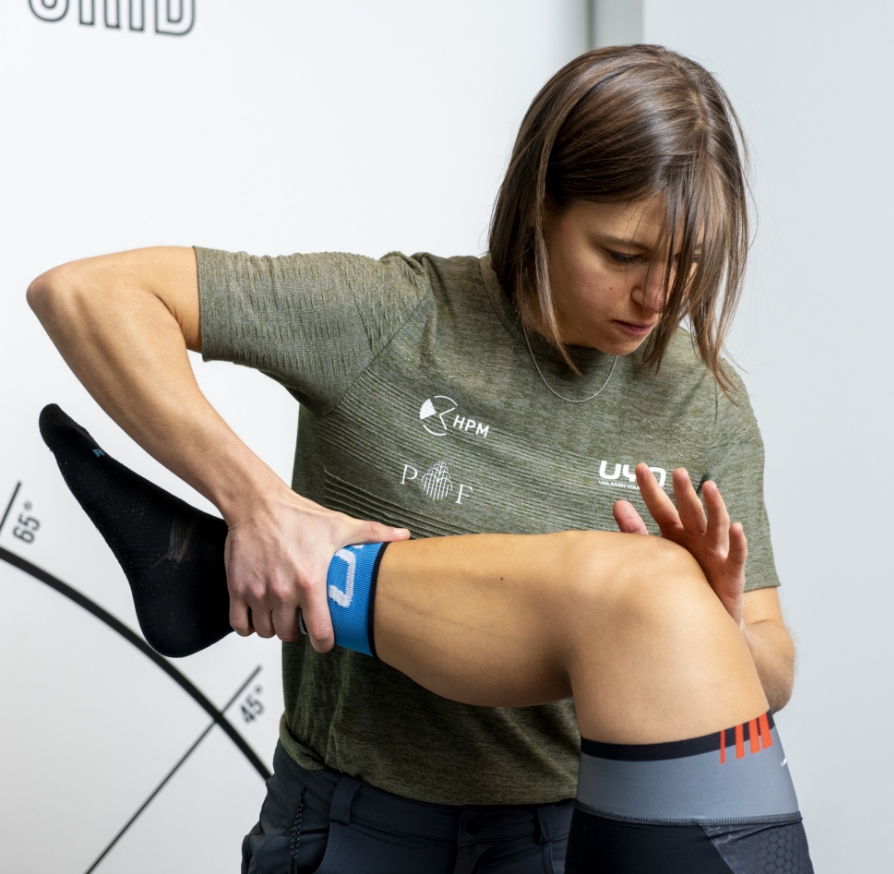
Massage is a manual therapy that acts on soft tissues (skin, fascia, muscles) with different purposes depending on the technique used.
Therapeutic massage
Recommended for pain, stiffness, muscle tone alterations, and functional recovery. It is often combined with therapeutic exercise and physical therapies.
Sports massage
Focused on preparation, recovery and load management: it can be pre-competition (stimulating), post-competition (cooling down) or maintenance during the season.
Relaxing massage
Aimed at reducing contractures and localised tension, improving mobility and the perception of muscle ‘release’, with intensity modulated according to the patient’s sensitivity.
Osteopathy
From a medical point of view, osteopathy is a manual therapeutic practice that deals with the assessment and treatment of musculoskeletal and fascial dysfunctions that can affect the functioning of the body.
It is based on three main principles:
- Unity of the body: the systems are interconnected.
- Self-regulation: the body tends towards balance.
- Structure-function relationship: structural alterations can affect function.
Osteopathic intervention aims to:
- improve joint mobility
- normalise muscle tone
- promote circulation and drainage
- reduce pain
Therapeutic/functional exercise
Recovery of mobility and strength
It consists of a set of active and passive exercises aimed at restoring proper joint movement and the ability of muscles to work effectively. It serves to reduce stiffness and weakness, improve body function and prevent injuries, often after a period of inactivity or a physical problem.
Pain and inflammation management
It includes strategies and treatments aimed at reducing discomfort and the inflammatory response of tissues, promoting recovery and well-being. The goal is to improve quality of life and allow a gradual return to normal activities.
Prevention
It is the most effective way to maintain stable performance, reduce forced stops and protect the body in the medium to long term. We use objective assessments and movement analysis technologies to identify key risk factors early on, such as asymmetries, lack of strength and control, mobility limitations, stability deficits and signs of overload. Catching these things early means we can do something about them before they turn into pain, inflammation, or injury. Based on the results, we build specific rehab and strengthening programmes with targeted, progressive exercises to reinforce the most vulnerable areas and improve stability, strength, mobility, and load-bearing capacity. Prevention is smart management of the athlete system: recovery, sleep, nutrition, stress, and weekly load. That’s why we also provide practical guidelines on habits and strategies that support physical resilience to help keep the body in optimal condition over time.
Pre-operative preparation
It includes exercises aimed at improving strength, mobility and movement control before surgery, preparing the body for the operation. It also includes an important mental aspect, aimed at reducing anxiety and fears, increasing awareness of the rehabilitation process and approaching the operation with greater serenity and confidence.
Post-operative rehabilitation
An injury is an event that alters loads, movement, confidence and performance. At HPM, rehabilitation is a structured and progressive process that aims to reduce pain and rebuild the ability to tolerate loads, using an approach consistent with modern literature. It starts with an initial assessment with clear objectives and continues with progressions based on objective criteria and measurements.
The programme is personalised and guided by an integrated team, using technology and functional tests to quantify the starting point and monitor progress (strength, mobility, neuromuscular control, ability to absorb and produce force, quality of movement).
Management of chronic conditions
Neurological and postural disorders (scoliosis) are managed through functional exercises designed to restore daily activities and achieve maximum independence.
Motor and vestibular re-education (proprioception)
It is a series of exercises aimed at improving balance, coordination and spatial awareness, helping the nervous system to better control movements and prevent instability and falls.
Walking and running rehabilitation
It consists of recovering a correct walking and running pattern through specific exercises, with the aim of making movement more efficient, safe and functional for daily or sporting activities.
Return to play
The next phase is re-athletisation, which in practice coincides with the Return to Sport (RTS) programme. Here, the goal is to bridge the gap between “feeling well” and “being ready” through:
- metabolic and neuromuscular reconditioning
- gradual reintroduction of sprints, changes of direction, jumps, contact or specific movements
- management of loads and intensity peaks typical of the sport
- work on psychological factors (confidence, fear of re-injury, readiness)
The return is therefore supported by progression criteria and tests to analyse symmetry and levels of strength/power, quality of movement, load tolerance, specific performance and subjective indicators. The goal is always a safe, measurable and sustainable return, to reduce the risk of recurrence and rebuild performance over time.
Develop and train your potential
We look forward to working with you to reach your full potential. Fill in the form and book an appointment to learn about our method.